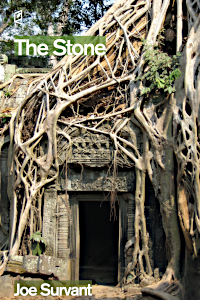
The Stone
Reading these new and selected poems by accomplished poet Joe Survant is a form of travel, a spiritual experience, a pilgrimage to visible and invisible worlds.
"Embarking from Malaysia where he taught in the mid-80s, Joe Survant's poems in The Stone resonate with the energy and insights of West meeting East, creating a travelogue of cultural and spiritual explorations that teach us that the world is wider and more diverse than we too often imagine it from the comfort of our couches and familiar neighborhoods. These poems teem with mystery and myth and give us what one of the poem's shamans describes as the "world without its skin," embodying universal truths from what for many of us is a new and alluring perspective."—Richard Taylor
From the Book
Conversation with the Shaman
What Others Say
The Stone: New and Selected Poems from Asia is another gift from Joe Survant's treasury. "The Jungle Letter To My Wife" begins colloquially enough—"There was something I wanted to say,". In the next stanza, a "strangler fig" appears (like Chekhov's Act I pistol) / whose slow aerial life / brings down the greatest tree." The pistol shot arrives 3 lines later: "the terrible secret / hummed unheard / within you, a seed / some wayward bird / dropped carelessly / in the warm bark high / up your body's tree." Survant's effortless, skillful joinery in this poem previews what's evident in every poem. No jungle splendor exists without terrors. Risk is the price of rapture. Survant reveals the journey, laid (like Snyder's Rip Rap) word by word, guiding us towards deep feeling and wisdom. I urge you to read this book.
Like snow falling in the rainforest, these poems are surprising, mysterious. They startle with images both strange and familiar, and let us travel to new places in both the world and the heart.
Embarking from Malaysia where he taught in the mid-80s, Joe Survant's poems in The Stone resonate with the energy and insights of West meeting East, creating a travelogue of cultural and spiritual explorations that teach us that the world is wider and more diverse than we too often imagine it from the comfort of our couches and familiar neighborhoods. These poems teem with mystery and myth as Survant adroitly dispels the vague impressions most of us harbor of Southeast Asia. They give us what one of the poem's shamans describes as the "world without its skin," embodying universal truths from what for many of us is a new and alluring perspective. They offer a new dialect to the truths of suffering and spiritual transcendence that are at root our universal human language.
About the Author