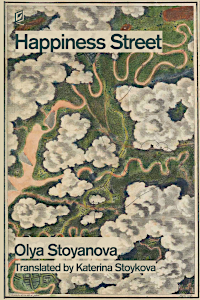
Happiness Street
Family relationships, travel and the importance of everyday connections take center stage in the sparse, deceptively simple poems in this award-winning poetry collection by Bulgarian poet Olya Stoyanova, translated by Katerina Stoykova.
"In this spare yet expansive poetry collection, the Bulgarian poet Olya Stoyanova is an inveterate, incisive people watcher, reading the faces of strangers the way some of us read books: avidly, greedily, including between the lines. You feel her scanning, recording and interpreting what she sees in faces glimpsed on sidewalks, in windows and doorways in cities around the world. Then, in a series of imaginative leaps, she infers and invents tiny dramas that are nonetheless decisive. Nothing less than urban life itself, in all its crowdedness and isolation, is contained in these often quietly desperate poems."—Kevin Nance
From the Book
Small Stories
What Others Say
Reading the poems in Olga Stoyanova's Happiness Street ignited an existential lobe in my brain. I wish I had an MRI printout to prove it. The poet replaces the question "why am I here" with "how did I get here" and "where am I going," said journey both literal and figurative. In "Bread," the practical woman who peddles the title food waits for buyers to come to her because: "the bread is like the sun—/early morning/it will rise on its own,/by evening/there will be nothing left." In the three lines of "Describing a Feeling" the speaker says: "Patience is/kneading bread when you/know it's not enough." Never having quite enough food also means never having quite enough time or love or energy, but these poems transport the reader over land, by sea, and through clouds to celebrate human resilience tinged with irony.
In her spare yet expansive poetry collection, Happiness Street, the Bulgarian poet Olya Stoyanova is an inveterate, incisive people watcher, reading the faces of strangers the way some of us read books: avidly, greedily, including between the lines. You feel her scanning, recording and interpreting what she sees in faces glimpsed on sidewalks, in windows and doorways in cities around the world. Then, in a series of imaginative leaps, she infers and invents tiny dramas—"Small Moments," one of her section titles, applies just as well to the overall volume—that are nonetheless decisive. Nothing less than urban life itself, in all its crowdedness and isolation, is contained in these often quietly desperate poems. Stoyanova makes an excellent guide.
About the Author