
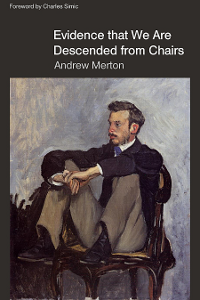
Evidence that We Are Descended from Chairs
"Andrew Merton's poems have many qualities that are both pleasurable and startling. He demonstrates the simplicity that is only gained by hard application, he brings a wry approach that flips the reader from an ambience of ironic nostalgia into the abyss of historical violence and personal grief, he mixes a playful surrealism with the knack of capturing both the hilarious and the deadly, and pulls off the visual psychologist's trick of making the familiar strange and puzzling. All of this is delivered in that most serious of all modes, a graceful sense of humour. This is one of those collections you will often re-read." - Rory Brennan
From the Book
Time Travel in the Grand Canyon
What Others Say
Andrew Merton's poems have many qualities that are both pleasurable and startling. He demonstrates the simplicity that is only gained by hard application, he brings a wry approach that flips the reader from an ambience of ironic nostalgia into the abyss of historical violence and personal grief, he mixes a playful surrealism with the knack of capturing both the hilarious and the deadly, and pulls off the visual psychologist's trick of making the familiar strange and puzzling. All of this is delivered in that most serious of all modes, a graceful sense of humour. This is one of those collections you will often re-read.
What is the national anthem of the country Andrew Merton inhabits? I think I hear ukuleles, and "the off-key bleats of a cracked bone kazoo" riffing out its tune. The music reminds us of the taste of five tart bites of a last peach, of our mother's ashes, of a galaxy blooming in a worn wicker basket. Relish these poems that will linger in your ear like a lover's cry. In the motherland of our broken and patched human minds, Merton sketches time's passage in lines as fluid as "a leaf in an uncertain breeze." Most of all, Merton teaches us to be a poem at any given moment of our lives.
A live current of existential terror, honestly engaged, runs through Andrew Merton's Evidence that We Are Descended from Chairs. The threats sometimes come from a sense of the abyss within, sometimes from the silent distances between us, and at other times from the irreparable wounds of history. Yet these threats are only part of the story that Merton's poetry tells. This is a book of restless imaginative energy, of surreal premises, of dream-like transformations, of a vision creatively skewed so as to see reality as if for the first time. Within all their terrors and transformations these poems brim with delight and astonishment at the minute particulars of our existence, the facts that are, as Frost once said, "the sweetest dream that labor knows.
About the Author