
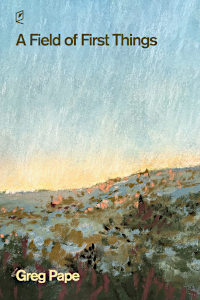
A Field of First Things
In A Field of First Things, you can read some of Greg Pape's best work, featuring narrative poems of beauty and compassion, poems addressing the complex interdependence between humans and the natural world.
"From Captiva Island's dock to a shared deep dive into Moby Dick, to the crashing waves in the South Bay, to a pool of mountain water, Greg Pape transports the reader across liquid time. Imbued with the trust of a loyal dog, we ride along like Lulu, marveling at Sandhill cranes and bucks in the Bitterroots, stare out at wide open mysterious desert nights and back into the still wet lives of people who have earned their venerable places in a constellation of shimmering memories. A Field of First Things allows the reader to experience the full power of a master poet who carries us willingly along on a journey where we are at once the ocean and the whale. And we all rise to the surface better for it."—Frank X Walker
From the Book
Dick Dale & The Del-Tones
What Others Say
Greg Pape's poems have long been touchstones of wisdom and clear-eyed seeing, and this new book confirms his place as one of our essential poets of the natural world, a rare and true inhabitant, here for the duration.
There is a profusion of sublime recognitions in this, the latest of Greg Pape's numerous collections that is perhaps the capstone to his fine career as a poet. As a child of California myself, I see deeply into his poems of recollection set in South Bay Los Angeles, Redondo Beach pier, fields of agricultural bounty in Fresno, set also among teen surfers, youthful hippies, and nighthawks in diners up and down the coast. But Pape's travels range farther—into the Florida Keys, Montana and throughout the West, even to Rome. Throughout, I recognize his compassionate portraits of the working poor, fellow field workers in California's Central Valley, young firefighters in the Sierras, indigenous kids playing basketball in Arizona, and an homage to a North Beach stripper. Heart is at the center of all this, "a tenderness towards existence," as Rilke recommended, and he gives it even to a deer trapped in a snare. to a porcupine, sandhill cranes, mariposas, hummingbirds, a flamingo, and a pet dog named Keats. And there are allusions galore to his studies in literature and classical American rock'n roll from Melville to T'ao Ch'ien, Whitman to the Sons of Champlin. We share much of these crossings of human feeling—the admiration for those who struggle and lose, who triumph and lose, who love and lose that too. His book is a furling face of the mounting wave of his entire life, the sweep of a fine and articulate nature, its torque of fulminating emotions, and the sweet foam of joy with its glister of gladness even in the troughs of sorrow. Greg Pape is my kinsman and brother, myself made otherwise by all his wisdom.
From Captiva Island's dock to a shared deep dive into Moby Dick, to the crashing waves in the South Bay, to a pool of mountain water, Greg Pape transports the reader across liquid time. Imbued with the trust of a loyal dog, we ride along like Lulu, marveling at Sandhill cranes and bucks in the Bitterroots, stare out at wide open mysterious desert nights and back into the still wet lives of people who have earned their venerable places in a constellation of shimmering memories. A Field of First Things allows the reader to experience the full power of a master poet who carries us willingly along on a journey where we are at once the ocean and the whale. And we all rise to the surface better for it.
Moving with the sure steps of Levertov's dog in "Overland to the Islands," in A Field of First Things, Greg Pape waves to Melville and Dante, Wordsworth and Frost, Whitman and T'ao Ch'ien. "Miracles / and catastrophes abound, and in childhood / they take on an especially personal tone," Pape tells us, and these poems are, indeed, haunted by experiences the younger self did not have words for—one, in particular, when a beloved collie is left behind and "that first heaven of contentment collapsed." Written by a poet who came of age under the twinned shadows of The Bomb and large-scale clear cutting, "Road Trip with Lulu," a marvelous long poem featuring an aging black retriever as co-pilot, is a gravitational field for the poems in this remarkable book that is most of all a songline for feeling one's way in the world.
About the Author